Mark Berryman
 Mark
was born in Towednack, Cornwall in 1796. In 1816, he married Mary Broad in
Redruth, and shortly thereafter moved to Brecon in South Wales. They had a son,
William Humphrey Broad Berryman, but Mary apparently died shortly afterwards. In
1831, Mark married a widow, Margaret Charles, and had seven children: Henry,
Matthew, Margaret, Sampson, Elizabeth, John and Robert. They lived in "The
Struet" in Brecon, and Mark's occupation is listed in the 1835/1837 Pigot's
Directory under Shopkeepers & Dealers in Groceries and Sundries, and in the 1851
Census of Brecon, he is described as a "currier".
Mark
was born in Towednack, Cornwall in 1796. In 1816, he married Mary Broad in
Redruth, and shortly thereafter moved to Brecon in South Wales. They had a son,
William Humphrey Broad Berryman, but Mary apparently died shortly afterwards. In
1831, Mark married a widow, Margaret Charles, and had seven children: Henry,
Matthew, Margaret, Sampson, Elizabeth, John and Robert. They lived in "The
Struet" in Brecon, and Mark's occupation is listed in the 1835/1837 Pigot's
Directory under Shopkeepers & Dealers in Groceries and Sundries, and in the 1851
Census of Brecon, he is described as a "currier".
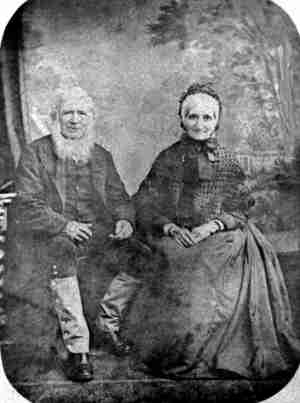
This photograph has been dated between 1884-1891, and was taken by a Brecon
photographer, Henry Hobbis. It is believed to be of Mark and Margaret. The
photograph was discovered by Alan Berryman in the effects of Mark's
great-granddaughter, Gladwys Goldsworthy ("Auntie Daisy"). I have not yet found
Mark in the 1861 census; but if the photo opposite is indeed of him, we can
assume that he made it to at least 1884 (88 yrs old).
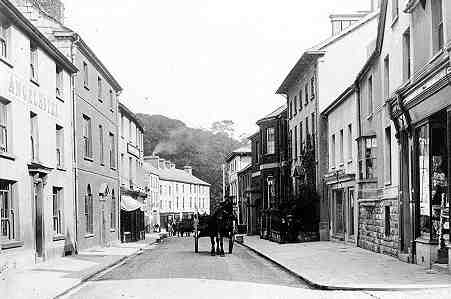
The Struet, about 1900
What was a "currier"?
The trade of currying was a vital part of the early leather industry. Currying
was the name given to the process of stretching and finishing tanned leather,
thus, rendering it supple and strong for the use of a saddler or cobbler.